Percussion Massager vs Foam Roller: What to Use After a Workout
Foam rollers and handheld massagers solve different problems. Here is how to decide which one to reach for — and how the two work together in a simple recovery routine.
3 min read
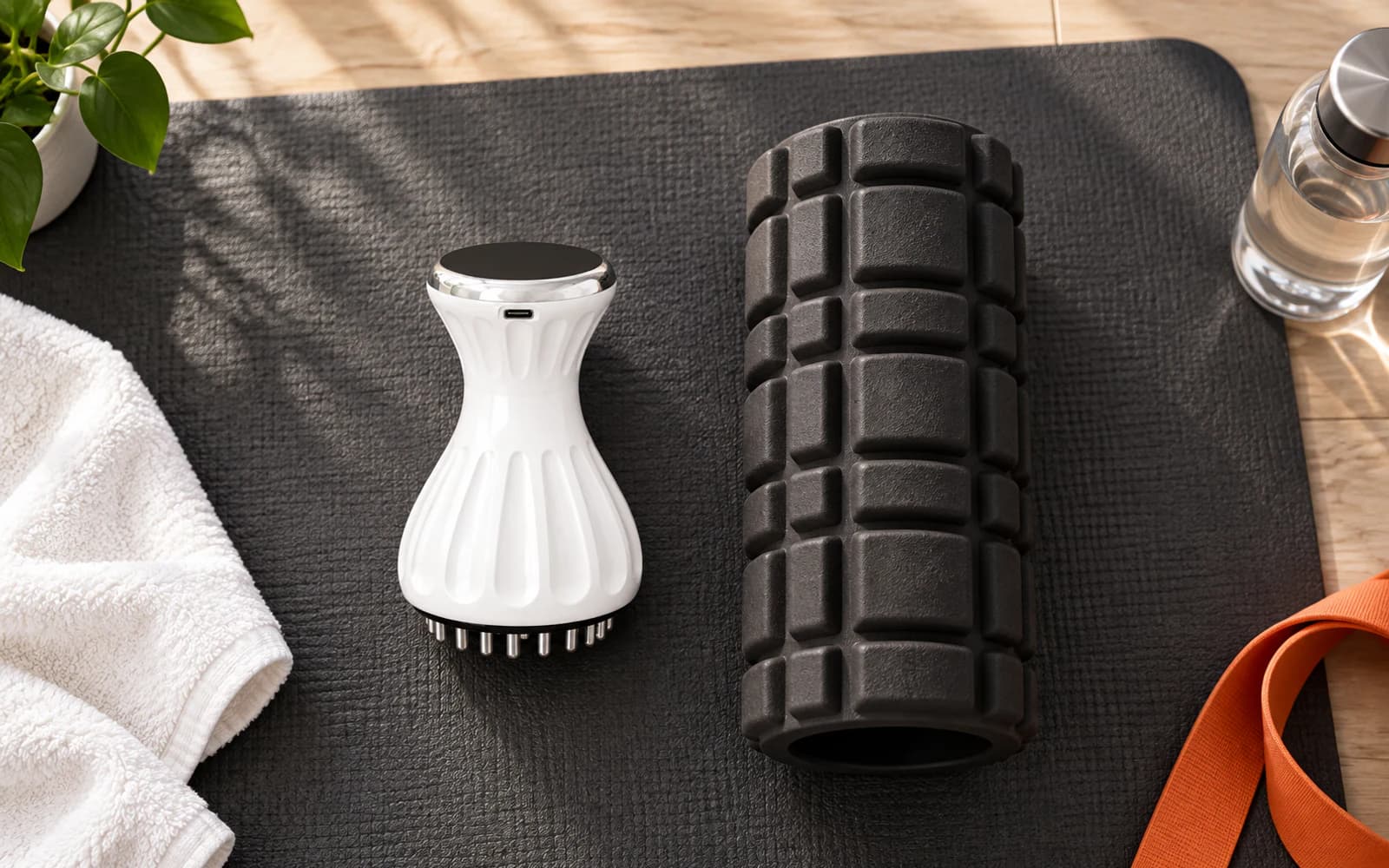
Walk into any gym and you will see both: someone parked on a foam roller near the mats, and someone working a handheld massager into their calves. They look like competitors. In practice they do different jobs, and most people get better results using both.
The quick comparison
| Foam roller | Handheld massager | |
|---|---|---|
| Best at | Broad areas, large muscle groups | Specific spots and tight knots |
| Pressure source | Your body weight | Your hand and the device |
| Precision | Low — it is a wide surface | High — targeted contact head |
| Portability | Bulky, floor space required | Fits in a bag, usable anywhere |
| Best moment | Before training, or a longer session | Anywhere, including at a desk |
| Learning curve | Moderate — position matters | Almost none |
The short version: a roller covers territory, a massager covers detail.
When a foam roller wins
Rollers shine on large, forgiving areas — quads, hamstrings, glutes, lats. You can settle onto them and let body weight do the work, which makes them ideal for a pre-training pass when you want to cover ground quickly.
They are also genuinely useful for people who like a slow, deliberate routine. Rolling forces you to get on the floor and stay there for ten minutes, which is its own kind of discipline.
Where they struggle is precision. If one spot near your shoulder blade is unhappy, a six-inch-wide foam cylinder is a blunt instrument — and pressing harder often just makes it worse.
When a handheld massager wins
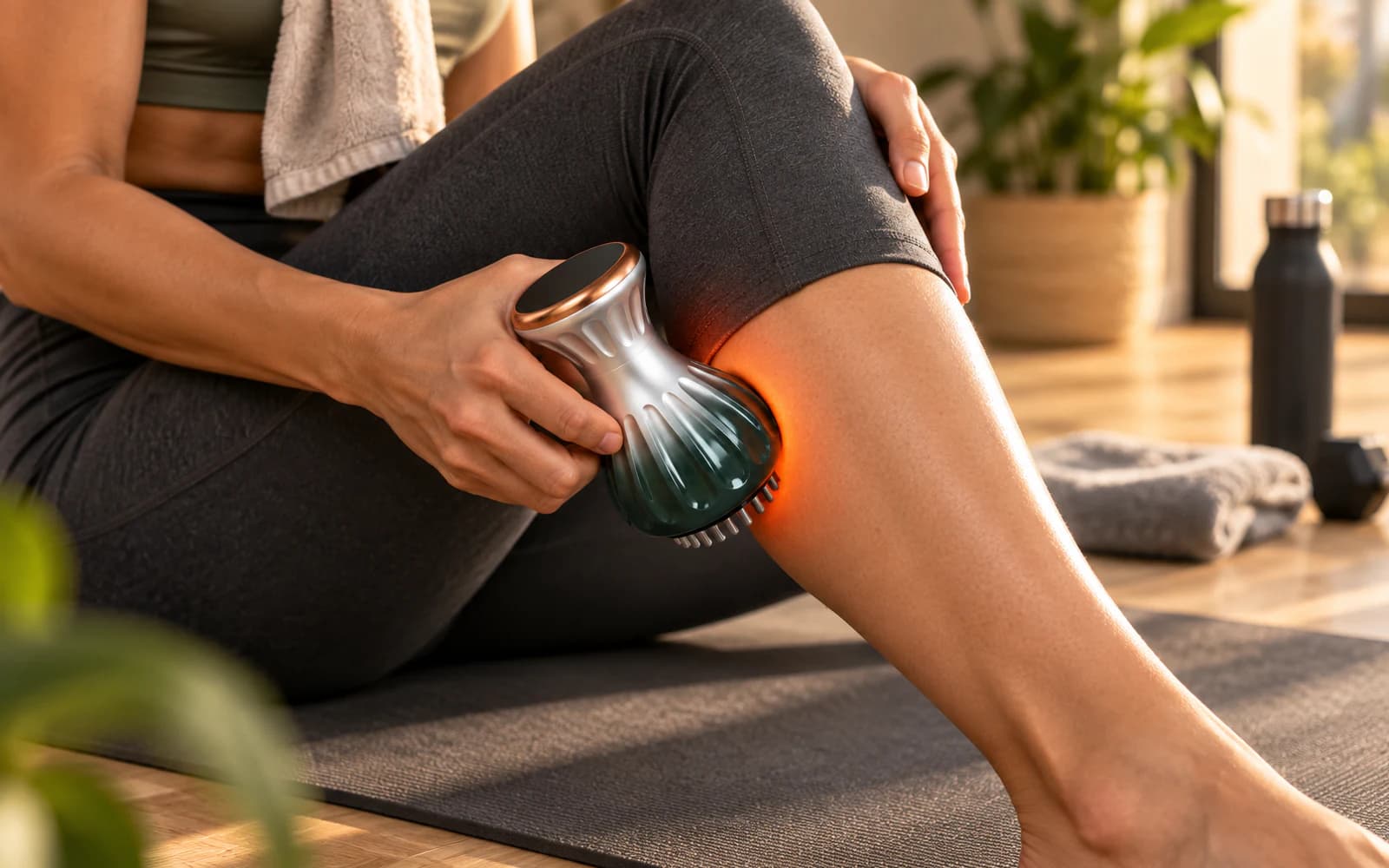
A handheld massager puts control back in your hand. Three things follow from that:
- Targeting. You can sit on the tight spot and stay there, which is hard to do with a roller.
- Access. Upper traps, forearms, calves, feet, even the area around the shoulder blade — places a roller cannot reach without awkward contortions.
- Timing. No floor, no mat, no changing clothes. That makes it realistic after a workday, not just after a workout.
The Abitmax massager adds two useful options here: three vibration levels for depth, three EMS levels for a gentler pulsing approach, and three heat levels with a red-light ring to warm an area up before you work it.
A simple two-step routine
If you want one routine that uses both tools well:
- Roll first (3–5 minutes). Cover large areas with light pressure to get things moving.
- Massage second (5–8 minutes). Move to the specific spots that still feel tight. Start warm — two minutes of heat — then use vibration or EMS on the area, keeping pressure steady rather than heavy.
- Finish light. Drop to the lowest level for the last minute. Recovery should leave you feeling looser, not beaten up.
If you only own one tool, the handheld massager is the more flexible choice: it works on the spots you already know are a problem, and it travels with you.
Five mistakes worth avoiding
- Going too hard on day one. Soreness from recovery work is counterproductive. Start on level 1 in every mode.
- Using vibration directly on bone. Keep the contact head on muscle tissue.
- Skipping the warm-up. Heat first makes the deeper modes feel far better.
- Chasing a "no pain, no gain" feeling. Discomfort that makes you tense up defeats the purpose.
- Ignoring the rest of the basics. Sleep, hydration and protein do more for recovery than any device.
Which should you buy first?
If your tightness lives in big muscle groups and you enjoy a floor routine, a roller is cheap and effective. If your tightness lives in specific spots — or if you know you will not get on the floor — a handheld massager with adjustable modes will get used far more often, and consistency beats intensity every time.
See the Abitmax VIB / EMS / HEAT massager — 9 settings, red light and a 3,000mAh USB-C battery, or find the current listing on Amazon.
Put the advice to work
Both Abitmax products are available on Amazon with live pricing and delivery estimates for your ZIP code.